
 ACCESS
Review Article
ACCESS
Review Article
Volume 2, Article ID: 2025.0029

Arbiona Shukulli
arbionashukulli@precacollege.org


Rahaf M. Ahmad
700039113@uaeu.ac.ae

1 Preca College, Rruga Pandeli Vangjeli 5, Korçë, Albania
2 Department of Genetics and Genomics, College of Medicine and Health Sciences, United Arab Emirates University, United Arab Emirates
* Author to whom correspondence should be addressed
Received: 31 Jul 2026 Accepted: 15 Dec 2025 Available Online: 31 Dec 2025
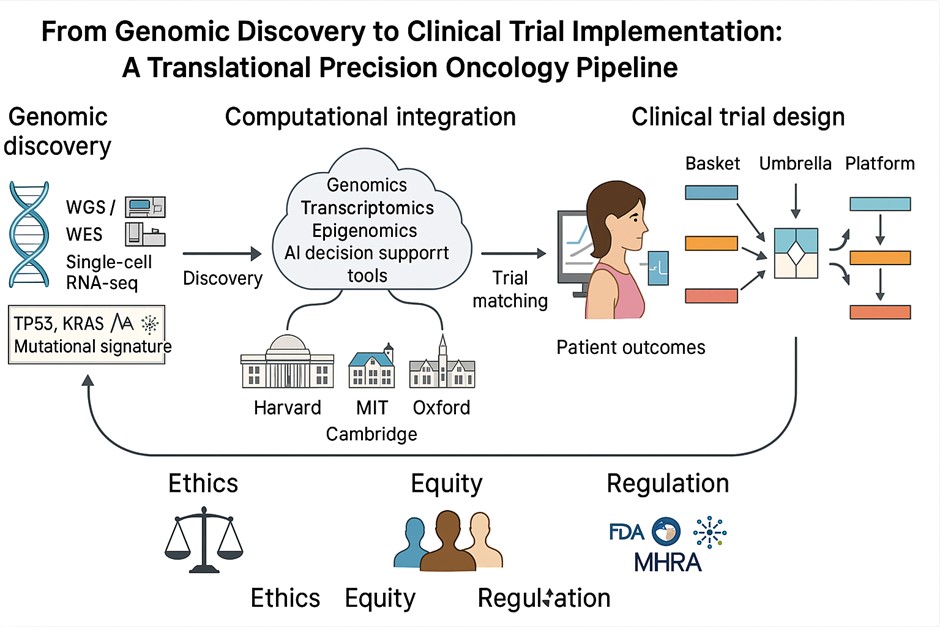
Precision Oncology has brought about a complete paradigm shift in cancer treatment approaches from Histology-guided regimes to Genomic-anchored, precision-cancer therapies. This paper reviews the major milestones in basic translational work in cancer genomics, evolution in clinical trial designs, and translational activities led by top Universities such as Harvard, MIT, Oxford, and Cambridge. This paper describes the major translational breakthroughs such as The Cancer Genome Atlas (TGCA) project, Functional Genomics with CRISPR, Live Sequencing platforms like MatchMiner, and underscores the need for their collective advancement in stratifying patients and personalizing treatments. This paper also showcases how cases from major institutions have aided in integrating multi-omics, adaptive clinical trials, and ethical AI approaches in the realm of research and clinical practice. Digital Twin models in MIT, GenOMICC in Oxford, and Spatial Omics in Cambridge demonstrate diversified, mutually supportive approaches in the realm of translational precision medicine. Emerging approaches such as Single-Cell Sequencing, Spatial Omics, AI-enriched clinical trials demonstrate an imminent future marked by learning health platforms. The paper also underscores the impending issues in Equity, Harmonization, and variant understanding, contrary to the basic scientific breakthroughs. Disparities in clinical trials and a lack of representation in diverse populations might accentuate global health inequities. We believe Precision Oncology mustering pioneer breakthroughs in Technological, Governance, Political, and Ethical domains. This paper also offers an inclusive blueprint in demarcating the limitations in Precision Oncology, intersecting Genomic Understanding, innovative clinical trials, and Socio-politics, prying into pioneer breakthroughs in treatments from renowned institutions to universally practical approaches in global health ecosystems.
Disclaimer: This is not the final version of the article. Changes may occur when the manuscript is published in its final format.