

 ACCESS
Research Article
ACCESS
Research Article
Volume 2, Article ID: 2025.0017

Hayder Abdul-Amir Makki Al-Hindy
phar.hayder.abdul@uobabylon.edu.iq

Department of Pharmacology and Toxicology, College of Pharmacy, University of Babylon, Babylon 51001, Iraq
Received: 07 Aug 2025 Accepted: 03 Dec 2025 Available Online: 09 Dec 2025
Background: Major depressive disorder (MDD) has significant sex-specific changes in psychiatric manifestation, biologic, and clinical response to treatment. The current breakthroughs in machine learning and artificial intelligence (AI) provide novel possibilities to approach multidimensional, multifaceted datasets in psychoanalytic studies. Nevertheless, gender, oxytocin, inflammatory biomarkers, and clinical characteristics of MDD are not studied in detail, especially among people in the Middle East.
Objectives: This research aimed at examining sex-based variations in oxytocin, clinical, and inflammatory measures in adults with MDD. In addition to assessing the predictive value of these variables on the severity of depression, we also tested these variables using machine learning with AI.
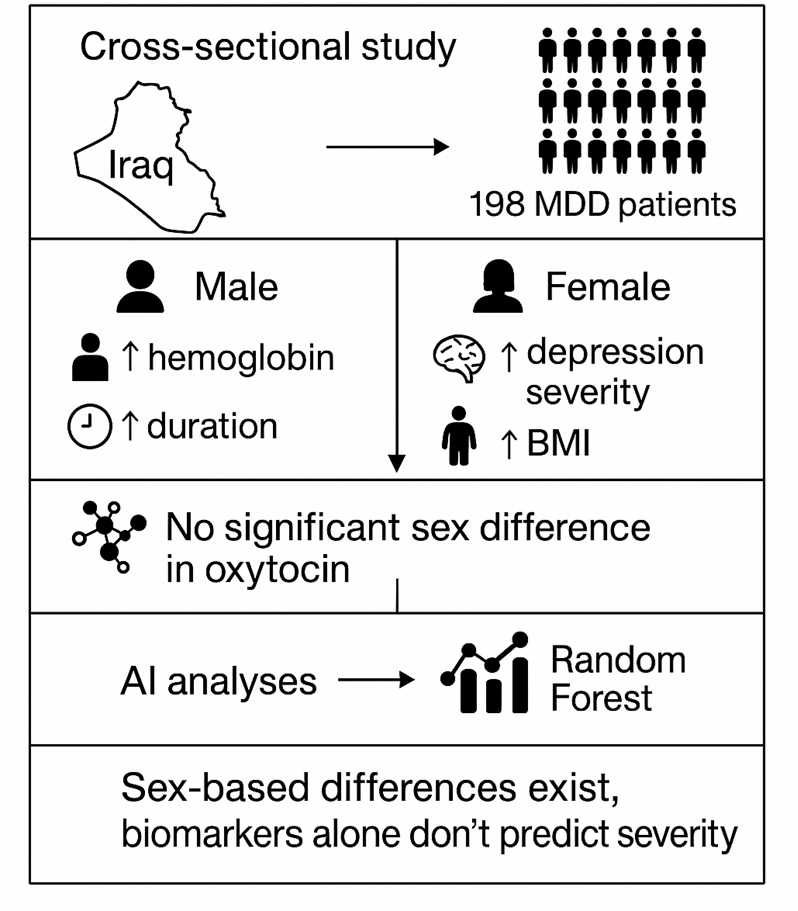
Methods: Cross-sectional research among 198 adults diagnosed as cases of MDD was conducted at Merjan Medical City, Babylon, Iraq (2022–2023). Sociodemographic, medical, in addition to lab data, including plasma oxytocin (calculated with ELISA, Enzo Life Sciences, Ca, USA), haemoglobin (Hb), leukocyte counts (WBCs), and body mass index (BMI), were collected. The severity of MDD presentation was evaluated through the “Patient Health Questionnaire-9 (i.e., PHQ-9)”. The statistical analyses encompassed t-tests, MANOVA, and logistic regression. AI-machine learning-analyses comprised principal component analysis (PCA), Random Forest classification, and K-means clustering.
Results: Females were found to have a severity of depression (p = 0.010) and BMI (p = 0.0002), and males were found to have significantly greater hemoglobin levels (p < 0.001). There was no difference in Oxytocin or WBC. MANOVA established that there are significant multivariate effects of sex on severity of the depressive symptoms, oxytocin, and WBCs (p=0.001). Logistic regression indicated that no single biomarker was significantly associated with severe depression. The model of the Random Forest was able to classify correctly the non-severe cases, but not the severe ones; the importance of each feature was insignificant. K-means clustering proved to have moderate sex-based segregation with partial overlap.
Conclusion: Clinical and biological differences between sexes are also observable in adult patients with MDD in Iraq, though single biomarkers, such as oxytocin, are only partially predictive of the severity of depression. Although limited by data in this research, AI-based analyses help to emphasize the complexity of depression and the necessity of multifaceted and sex-sensitive risk stratification in addition to personalized care.
Disclaimer: This is not the final version of the article. Changes may occur when the manuscript is published in its final format.