


 ACCESS
Research Article
ACCESS
Research Article
Volume 2, Article ID: 2026.0025

SK Wasim Ahmed
wasim.microbiology@tripurauniv.ac.in


Espita Palwan
espita.microbiology@tripurauniv.ac.in


Soumya Samal
soumya.microbiology@tripurauniv.ac.in


Shaon Ray Chaudhuri
shaonraychaudhuri@tripurauniv.ac.in

Microbial Technology Laboratory, Department of Microbiology, Tripura University, Suryamaninagar, Tripura West, Tripura 799022, India
* Author to whom correspondence should be addressed
Received: 15 Jul 2025 Accepted: 01 Jan 2026 Available Online: 08 Jan 2026
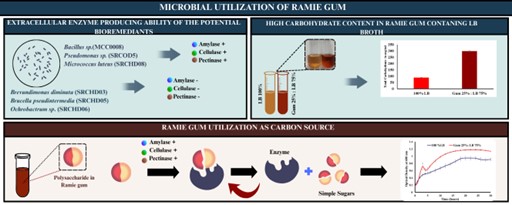
Ramie (Boehmeria nivea) contains approximately 30-35% gum, composed of cellulose, hemicellulose, lignin, pectin and waxes. Ramie gum is a rich source of carbon, which can be utilised as a media component for growing microorganisms. The current study was conducted to investigate the mode in which Ramie gum stimulates the growth of different bioremediating bacterial strains. The high concentration of total carbohydrate in the Ramie gum substituted Luria Bertini (LB) broth enhanced the log phase of growth substantially for Bacillus sp. (MCC0008), Micrococcus luteus (SRCHD08), and Pseudomonas sp. (SRCOD5) being cellulase, amylase and pectinase producing strains. Bacterial strains Brevundimonas diminuta (SRCHD03), Brucella pseudintermedia (SRCHD05), and Ochrobactrum sp. (SRCHD06), which were non-producers of cellulase, amylase and pectinase, showed no impact of Ramie gum substitution in LB on their growth. These extracellular enzymes (cellulase, amylase and pectinase) can degrade cellulose, hemicellulose and pectin, producing bacteria-utilizable sugar compounds. The stimulation of biofilm formation might be attributed to the presence of pectin and xylan in the gum through the involvement of the Spo0A gene. The strains showing higher growth and biofilm stimulation demonstrated higher bioremedial ability. Hence, a waste (the gum) that needs to be removed for spinning of the fiber can be appropriately valorised through use as a bacterial feed.
Disclaimer: This is not the final version of the article. Changes may occur when the manuscript is published in its final format.